Kids Table Clock Laser Cut SVG: A Designer’s Review
As an embroidery designer who spends half my life staring at digitized files and the other half wrestling with thread tension, I have learned to be skeptical of cross-category assets. When I first encountered the Kids Table Clock Laser Cut Nursery SVG, my initial reaction was one of caution. This is explicitly marketed as a laser cutting template for wooden nursery decor, not a native machine embroidery design. However, in the modern craft economy, lines blur. We often repurpose vector art for various mediums. The question isn’t just whether the file exists, but whether it holds up when translated from a laser beam to a needle.
I decided to test this concept by imagining a real-world scenario: a custom order for a boutique baby shower gift. The client wanted a cohesive theme involving time and growth, specifically requesting a clock motif on a high-quality cotton tote bag and a matching onesie. While the source file is intended for Laser Cutting within the Home Decor sector, its clean lines and animal-shaped silhouette offered a promising foundation for a simplified embroidered applique or a bold outline stitch. Here is my practical assessment of using this specific design asset in an embroidery context.
Visual Personality and First Impressions
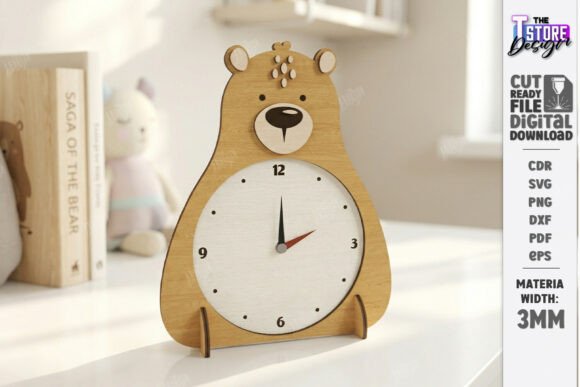
The immediate appeal of the Kids Table Clock Laser Cut Nursery SVG lies in its simplicity. Laser files require closed paths and minimal internal detail to ensure structural integrity when wood or acrylic is cut. For an embroiderer, this is actually a blessing. Complex, photorealistic designs often turn into muddy messes when stitched out on small hoops. This design, featuring an animal-shaped clock face, relies on strong, recognizable silhouettes.
The mood is playful yet educational. It avoids the clutter of excessive decorative elements, which makes it versatile. Whether you are aiming for a whimsical nursery vibe or a modern, minimalist aesthetic for a small shop product, the visual personality is adaptable. The "animal shaped" aspect suggests that the clock face is integrated into a creature—perhaps a bear, owl, or lion—which provides a natural frame for the numerals. This layout is crucial for embroidery because it defines the boundary of your stitching area clearly.
Translating Laser Vectors to Stitch Data
It is vital to understand that you cannot simply import a laser SVG into your embroidery software and expect magic. However, this file serves as an excellent design asset for tracing. When I evaluated the potential for this embroidery project, I looked at how the shapes would translate into stitch types.
The outer edges of the animal shape are perfect for a satin stitch or a thick running stitch border. This creates a crisp, defined edge that mimics the clean cut of a laser but with the texture of thread. The clock face itself presents a challenge. Laser files often have tiny numerals or tick marks. In embroidery, these must be scaled up significantly. If you attempt to stitch tiny laser-cut details on a tote bag design or a textured fabric, they will vanish. My advice is to simplify the internal details. Use bold, block-style numbers for the hours and consider using an applique design technique for the clock hands to reduce stitch density.
Real-World Application: The Baby Gift Scenario
Let’s return to the custom baby gift scenario. I envisioned using this motif on a soft, organic cotton onesie. For baby embroidery, comfort is paramount. A dense fill stitch covering the entire animal shape would be stiff and uncomfortable against a baby’s skin. Instead, I would use the Kids Table Clock Laser Cut Nursery SVG as a guide for a lightweight applique. I would stitch a running stitch outline, place a contrasting fabric piece underneath, and then finish with a satin stitch border. This keeps the stitch density low and the garment soft.
For the accompanying tote bag, I had more freedom. A canvas tote can handle heavier stitching. Here, I could experiment with a textured fill stitch for the animal’s body, using variegated thread colors to add depth. The clock face could be embroidered in a contrasting metallic or bright color to make it pop. This approach transforms a simple laser template into a high-value personalized gift. Customers perceive applique and mixed-media embroidery as premium work, which justifies a higher price point for your craft business.
Fabric Considerations and Technical Challenges
Not every fabric behaves the same way. When working with this design, you must consider the fabric texture. On a fluffy minky blanket, fine details will get lost. On a stretchy jersey knit for a sweatshirt, the design needs proper stabilization to prevent puckering. I strongly recommend using a cut-away stabilizer for garments that will be washed frequently, such as sweatshirt embroidery or baby clothes. A tear-away stabilizer might suffice for a decorative pillow cover that sees less wear, but for a functional item like an apron or tote, durability is key.
Dark fabrics present another challenge. If you are stitching on navy or black, the details of the clock face need to be light-colored thread to maintain visibility. I always test my digitized version of the design in black and white mockups first. If the contrast isn’t clear in grayscale, it won’t be clear in thread. This step saves hours of unpicking stitches later.
Commercial Viability for Etsy Sellers
For Etsy sellers and digital product sellers, the versatility of this design is a major selling point. While the original file is for laser cutting, creating a companion embroidery file based on this shape allows you to offer a coordinated collection. Imagine listing a "Nursery Time Theme" bundle that includes both the laser-cut wooden clock template and the matching embroidery file for clothing. This cross-promotion enhances brand consistency and increases average order value.
However, licensing is critical. You must verify the license terms of the original Kids Table Clock Laser Cut Nursery SVG. Does it allow for derivative works? Can you sell the embroidered finished products? Many laser files are for personal use only. If you plan to use this for commercial embroidery or sell finished product items, you must confirm you have the right to adapt the design. Never assume. Contact the creator if the terms are unclear. Protecting your small business from copyright issues is just as important as choosing the right thread color.
Practical Designer Notes for Execution
Before you commit to a large production run or a high-stakes client order, follow these steps:
- Test on Scrap Fabric: Always stitch a sample on the exact fabric type you intend to use. Check for registration issues between the outline and the fill.
- Check Hoop Size: Ensure the design fits comfortably within your hoop with enough margin for clamping. A cramped design leads to hoop burns and distorted stitching.
- Simplify Details: Laser cuts can be intricate; embroidery cannot. Remove tiny tick marks or replace them with simple dots or dashes.
- Contrast is King: Choose thread colors that stand out against the fabric. Low-contrast designs look amateurish and fail to capture attention in printable mockup previews.
- Inspect Corners: Sharp corners in laser files can cause thread bunching in embroidery. Round off sharp angles slightly in your digitizing software to ensure smooth stitching.
In conclusion, while the Kids Table Clock Laser Cut Nursery SVG is born from the world of laser cutting, its clean, graphic nature makes it a surprisingly strong candidate for embroidery adaptation. With careful digitizing, appropriate stitch selection, and attention to fabric behavior, it can become a standout element in your custom apparel or home decor offerings. It bridges the gap between educational tools and decorative art, providing a unique angle for makers looking to differentiate their handmade product lines. Just remember: respect the medium, check the license, and always stitch a test swatch first.